What I see when I bike to school:
the firehouse at Holly Park
somebody circling the neighborhood projects in an old Lincoln
Lelenita's Cakes shop all lit up
and, a block later, Adelita's Cakes
professional dog walkers and professional dogs
the 14, 49, 23, 44 and 29 buses, tires sighing
that long line of houses that start in Daly City and trickle all the way down to the beach
crossing guards in chartreuse
kids eating KFC for breakfast and sipping Cokes on their walk to school
Bank of America in Chinese
little hidden comic bookstores nudged in between taquerias
parking lots under construction
women in pantsuits and boys in baggy jeans en route to the City College
usually at least one optimistic skateboarder
delivery trucks transporting surprising products (i.e. scuba gear)
when I'm lucky, the sun
Friday, December 18, 2009


Thursday, December 17, 2009
an email that came out as a poem.
This is better, I think, if left unexplained.
k
so you could think of emails as receipts, yeah?
like a, hey, got this, don't need to write back,
just want her to know that i read it,
that i know she's crazy about me,
and it's cool for her to tell me that.
so maybe
don't write back
just, like, you know, press enter
or
write me a letter instead.
i deleted all my old text messages
(after saving them in a word document)
in honor of you.
also so my cheap phone could accept
your mustachioed face.
-
Wednesday, November 18, 2009
Thanksgiving and the Best Photo (Family) in the World

Sometimes I have these moments when something strikes me with surprising emotional weight, a magnet that pulls me back to ground. One of those moments when I am completely derailed in the act of doing something. I was cleaning my room the other day and stumbled across this photo wedged between my desk and the wall. I soon lost track of time and space, lying with my legs splayed out across the floor I was trying to uncover.
My childhood is a series of stories too long and colorful for a single blog entry, with hidden languages and deeply rooted riddles. Mine isn't any more precious or important than anyone else's. But I have yet to find a photo that captures as much as this one.
Why? Well, the first obvious answer is tie dye. Matching tie dye, nonetheless. Handmade matching tie dye, with more drying tie dye in the background, in case the clothes we were posing in weren't colorful enough. If you squint, you can make out my little tie dye hat hanging on the back "wall." Handmade matching tie dye made that week at family camp. Tent 19: that was our little half-cabin half-tent, our home for a week each summer for eight (count 'em) years.
And then there's the Birkenstocks and velcro shoes. My mom had the same green Birkenstocks for most of the 1990s, those telltale comfort shoes that gave us away when we visited the East Coast.
But perhaps the most telling thing about this photo is the fact that I'm smiling. Not only smiling, but laughing openly. I was deeply, frustratingly shy for most of my childhood. In most photos pre-adolescence, I'm frowning, crying, looking desperately away from the camera, have my hands in front of my face, or am trying to hide behind someone else. That was never easy, as I was a big kid. But this photo is different: this photo shows an honesty I didn't realize I was capable of at six or seven years old. It was summer. We were at camp. We had goddamned matching tie dye outfits. Maybe I actually saw how lucky we were -- are.
And now, twenty years later, the only remnant of my tie dye life is a single pair of socks, a birthday present from my mother that I still wear with regularity. We are all taller, with darker, shorter hair, we are educated professionals, we live in different cities, we have witnessed a few murky political administrations, cheered over personal victories and bemoaned our own unforeseen stumbling blocks.
As well documented as my life has been, and still is, I can't find a recent photo of the four of us, all in the same place at the same time. It will happen soon, I'm sure, but somehow I doubt we'll be in matching shirts, sitting in a row on wooden planks.
This is for them, for Thanksgiving. For my brother, the high school science teacher, the one who writes poems with ketchup, surfs on 11 different boards, and taught me stick shift. For my father, my favorite running partner with the ponytail, my personal pharmacist, the man who knows instinctively when I need help and has never judged me for it. And my mother, the woman who has taught me more than anyone that being "multi" is an asset in life; multicultural, multipurpose, multifaceted. Happy Thanksgiving, Team HJ, with love from the girl who finally smiled.
Monday, November 16, 2009
Giants, of sorts
Things that have happened in the past few weeks, in no specific order:
Two British men completed a five-month voyage from Japan to San Francisco. They rowed. As in, the two of them sat in a tiny shell, took turns rowing two hours on, two hours off, and together they crossed the Atlantic.
They shuffled beneath the Golden Gate bridge on Friday, November 13. I crossed the same bridge later that evening, just as the sun was beginning to set. I, too, was once rowed port, and sometimes calluses still surface, years later. These middle-aged men apparently had trouble staying on their legs once they docked, having spent nearly half the year seated in a boat. To think of the animals they must have seen, the zigzag of currents, passing liners and cruise ships, not to mention the slight possibility of pirates--there are few stories more remarkable.
A sadder story, also last week: The first fatality on the still-under-construction Bay Bridge. A 50-something Hayward truck driver took the new S-curve ten miles too fast and barreled over, crashing 200 feet to Yerba Buena Island below. He was transporting pears. I can't help wondering what that must have sounded like, and what pattern the fruit made as they hit the asphalt.
Saturday was World Diabetes Day. My parents went to Sacramento, where the State Capitol was lit up in blue. There is a strange comfort in knowing that the intricacies of diabetic life can now be recognized in a single color. As if by giving it a color, we are assigning it some manageable potential. I wonder how politicized the color choice was; if, by giving ourselves a ribbon, we are adopting our own font, a marketable campaign, a battle plan.

And that's fine--battle plans are fine by me. The silver lining of living with a chronic condition is knowing that, at any given moment, I can rejoin the campaign. It'll still be there for me when I have money to donate, or time to spare. The sucky times are evenings like one last week, when I excused myself from drinks with friends to run a lap around a block downtown. Because sometimes our bodies do these things. Make us blue.
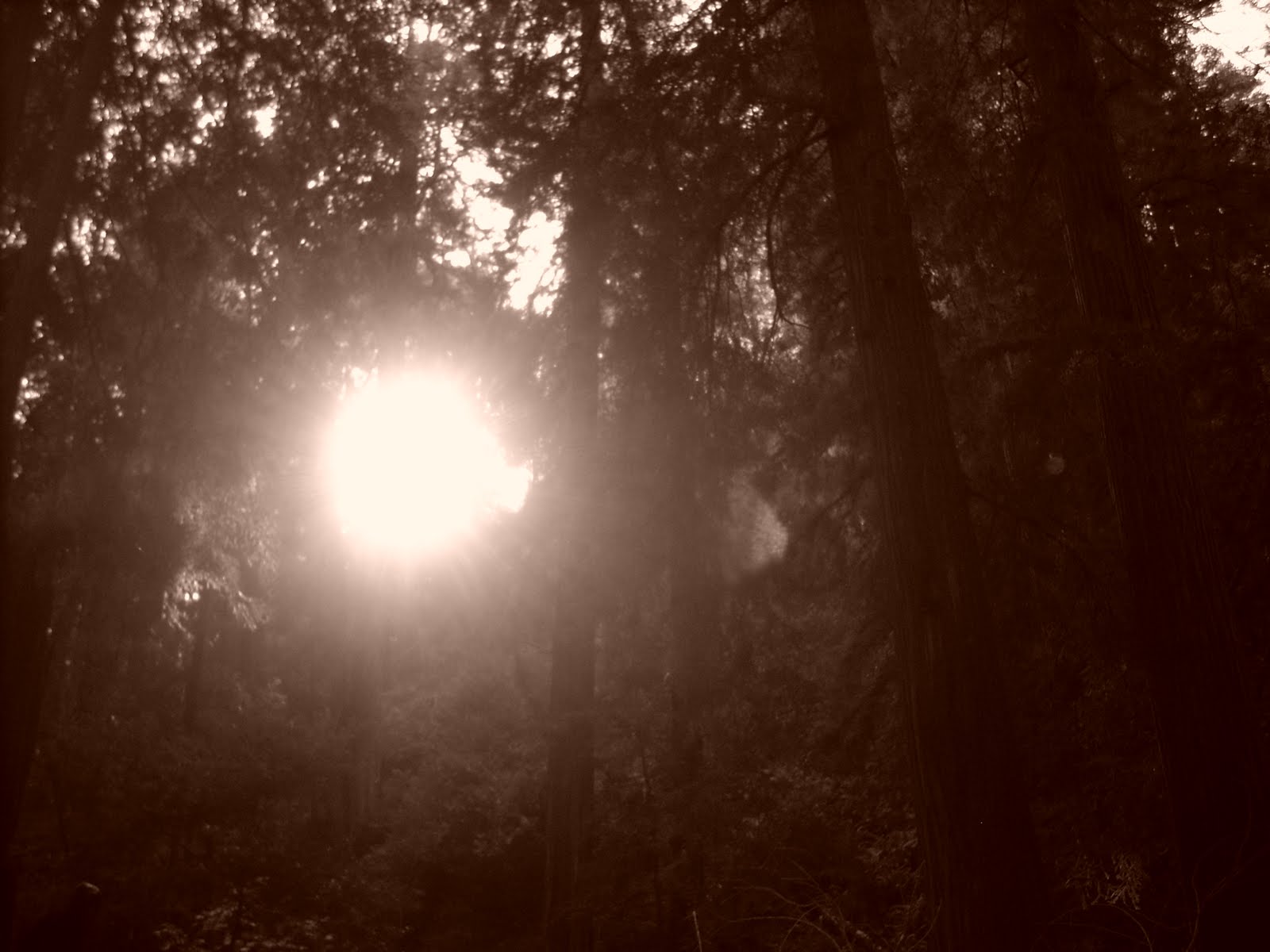
But perhaps the best part of the last few weeks: Muir Woods on a Sunday afternoon. My aunt lives in Marin County, and invited us out to house-sit while she was away. Muir Woods National Monument is a short jaunt from San Rafael, a surprising glimpse of insane coastal greenery. Walking amongst those trees, whose height and age already eclipsed my own a hundred times over, I felt all the blues shrink down. I had never noticed how multiple trees can grow quite seamlessly out of the trunk of an old redwood. The light was dappled in the way that it should be, little circles of yellow making patterns on the forest floor.

Sometimes we need more giants in our lives to remind us just how small we are. Or how the Atlantic can't be that big. That shit happens. Stories multiply; we just have to be awake enough to witness them happen.
Friday, November 6, 2009
Lost and Found, Part One
She was forever dropping things. Pens, spare change, grapes. Her phone's most important characteristic was durability; she'd dropped it so many times that her boyfriend called it "the lemming." She blamed it on her fingernails, which grew at an unnaturally fast rate. Her limbs acted as spokes of a great wheel, which made her a confident runner, but caused minor accidents on a regular basis.
"I think I just have an internal magnetic pull," she once joked to her neighbor, who gasped after she had tripped going up the stairs to her apartment. "My body wants to stay nice and close to Earth."
Perhaps it was Ariel's sympathy for fellow klutzes that gave her a keen eye for dropped items. Every day, when walking down the hill to the subway, she stumbled (quite literally) across some forgotten object. A pony-shaped barrette. A grocery list written in grandmotherly cursive. A small baggie full of laundry change. And once, an oversized key labeled "Property of--." The last few letters had been rubbed clean. Ariel turned the key over in her hands, looked once up and down the street for any signs of keyless wanderers. She held it up to the light, admired its curlicued edges and almost gothic charm. She dropped it once on the sidewalk, and then returned it safely to the deep pockets of her jeans. It was foggy day in early September, and Ariel was on her way to the local radio station, where she volunteered once a week. She resumed her walk, aware of the cold weight of the brass against her thigh.
Wednesday, November 4, 2009
On Subtlety
Del Ray Cross, San Francisco poet and editor of the online poetry journal Shampoo, came to speak in my class. We were assigned to read his collection Lub Luffly, an amalgamation of site-specific poems, largely inspired by New York School poets such as Frank O'Hara and Bill Berkson. My own interest in poetry has ebbed in flowed over the years; the poems that strike me often do so with a weight that nearly knocks me down. Otherwise, they leave little to no impression. I admire poems that surprise, that carry unexpected weight, that make you gulp. This poem falls into that latter category:

hanashi
by Del Ray Cross
While we talk
I'm not gonna
talk about
me or you.
A new sky
is formed
upon the
words we
don't use.
Two pillows
raised to it,
and a laugh
that starts in
one throat
and ends
in another.
The simplicity of his prose, paired with the short lines and even the poem's slender length, packs a hidden punch. The clear evasion of feeling is exactly what gives it its oompf. I can sympathize; these days I feel the need to swamp my brain with material, to saturate my life with small, manageable tasks that all at once must be creative and practical. But the moments I remember are rarely accomplishments, or even minor victories; instead they are the quiet ones, the innate ones, the shared glances or imperceptible nods. I hope to recapture a similar subtlety in my own writing.
Speaking of subtlety: A moment of shameless self promotion.
My first KALW radio story was played last week. The piece, "Creating Altars for the Day of the Dead," is my interview with Mexican paper artist Herminia Albarran Romero, who taught a series of workshops at the Mission Cultural Center for Latino Arts here in San Francisco.
More to come -- including a piece about local music label and record store Thrillhouse Records.
Maybe, sometime soon these projects and internships and personal explorations will result in a neat little poem, one that starts in the throat and ends on the page.
Sunday, October 18, 2009
On Learning to Write
Clarity comes in disguise. I think.

I'd like to peel through the fog sometimes, to suck the very condensation out of the air as it creeps over Twin Peaks and into the city. I find myself in a writing program where I am reading, critiquing, editing, and editing; that is, doing everything except writing itself. I can't tell if what I'm feeling is more the mismatched alchemy of being back in school again after three years working, or maybe if I've somehow trained myself to instantly miss that which I no longer do. The comfort of routine is something so embedded in my bones that I don't know how else to shake it off. That, coupled with an inbred pressure to get a job, any job, to look ahead, to afford health insurance (that which shackles me and so many others to jobs we don't love), to be practical, pragmatic, responsible, efficient.
I want to learn how becoming a better writer will solve all that. And the thing is, that's a tall order. Expecting some mind-altering short story or career-launching novel to suddenly give birth in my brain is a little like hoping, no, demanding, our current president to solve all the world's problems. Now that he's got a Nobel Peace Prize, he can get down to the nitty-gritty and actually be that change he promised us last year. Right?
Ever since I quit my job to start grad school, I find myself waking up every weekday with a hummingbird's heartbeat. The first thought on my mind is to get shit done. This is motivating, yes, and sometimes crazy-making. My dad always jokes that if I were a dog, I'd be a sheepherder, because I always need a job to do. The irony is that good writing is the one task that is really difficult to instantly produce. Coffee--that I know how to make quickly. I can answer phones. I can improvise a short lesson. But how does one demand creativity of oneself? The demand itself can kill an idea.
One way I've tried to jumpstart my creative brain is to take on multiple side projects. Every Monday I volunteer at KALW 91.7, a radio station based out of Philip Burton High School here in San Francisco. Every week, a team of reporters and volunteers produce Crosscurrents, a half-hour segment devoted to culture, context and connection in the Bay Area. I've done a few short interviews, have learned to use the recorders and hope to learn ProTools in the coming weeks.
I've also started blogging for Eduify, a start-up company whose aim is to use social networking to help high school and college students improve their writing. Writing these posts forces me to focus in on exactly I want to know as a writer myself, and what resources out there will help me and others develop. So far I've written two Halloween-themed piece (one on zombie romantic comedies, the other on Edgar Allan Poe), and interviewed children's book author and poet April Halprin Wayland. I've since done two other interviews, and will be interviewing a few more writers in the coming weeks.
All this to say that sometimes the things we want most desperately are the things we must go out and create on our own. Which is why I've always wanted to be a writer, and why at the same time it is a very hard thing to be. I saw music critic and radio host Greg Kot speak this past Friday at the Booksmith. His new book, Ripped, covers the revolution that has occurred in the music industry in the past ten years. Kot's main message was that the best artists are the ones who love what they do so much that they see their art as something they simply must do. Music as oxygen. Words--the continuation of our fingers. That's the urgency I feel when I get up in the morning: the need to do, to be, to act, to write.
And who knows? One of these days, maybe all these actions will add up. Until then, I'll keep my eyes on the horizon.
Subscribe to:
Posts (Atom)